Evolutionary Explanations of Religion
Religion can be examined at several levels without assuming that every belief or ritual evolved for the same reason. The diagram separates possible origins, the mechanisms that produce and transmit behavior, its consequences, and the conditions under which it might persist. These are research questions, not a single established evolutionary account.
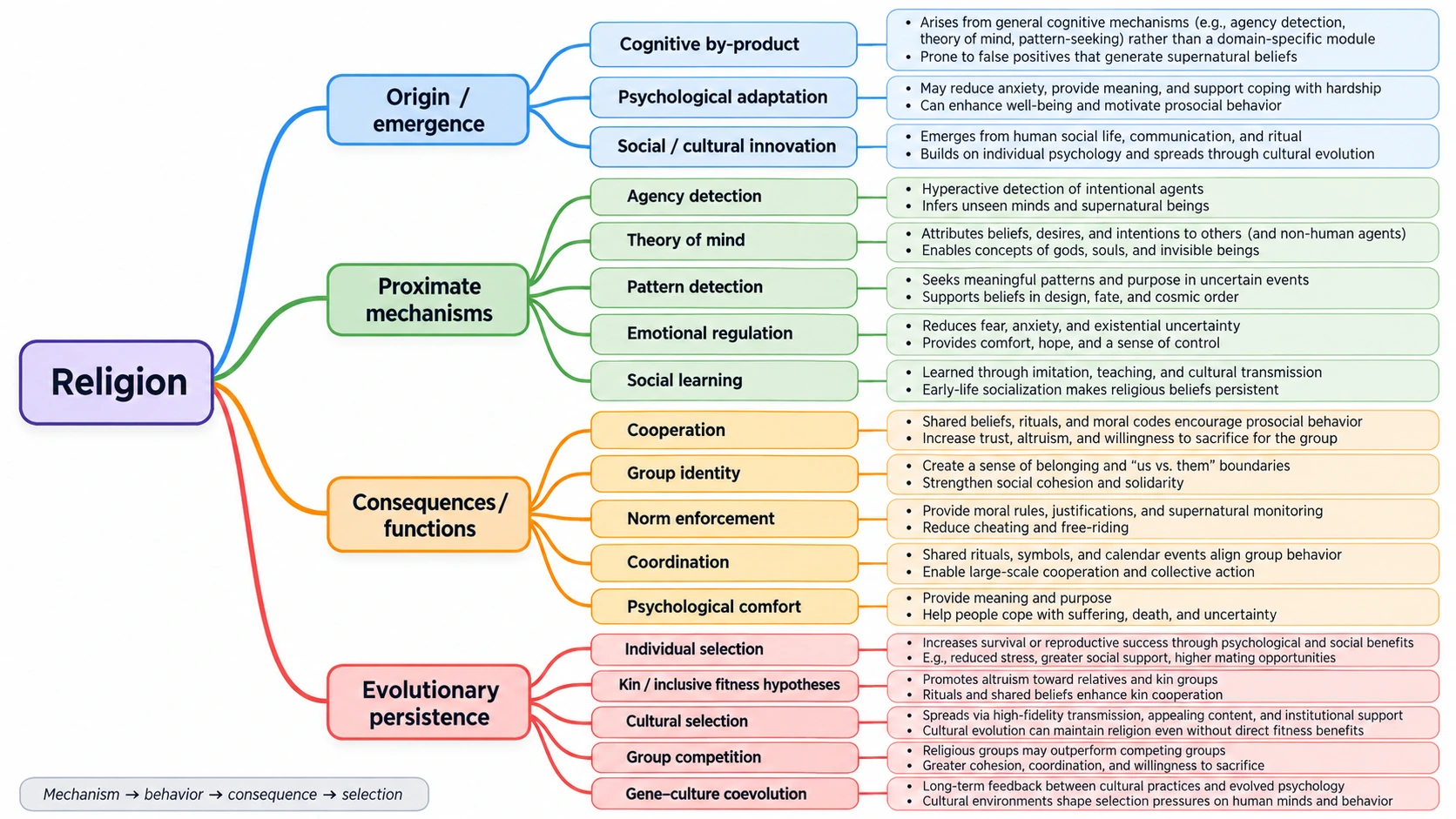
Reading the four layers
| Layer | Question | Example |
|---|---|---|
| Origin / emergence | How might a religious idea or practice first arise? | An existing capacity to infer unseen agents could make supernatural agents imaginable; a ritual might also be invented and transmitted culturally. |
| Proximate mechanisms | What produces and transmits it within a lifetime? | Agency detection, theory of mind, emotions, imitation, and teaching. |
| Consequences / functions | What effects does it have in a particular setting? | Ritual can coordinate a group; norms can alter cooperation and conflict; beliefs may provide comfort. Effects can also be neutral or harmful. |
| Evolutionary persistence | Why might it become more common across generations? | If its effects change reproduction or cultural transmission, selection might favor it at individual, kin, or group scales. These routes must be tested. |
The layers form a possible causal sequence, mechanism → behavior → consequence → selection. A present-day benefit does not by itself establish the original cause of a practice. A by-product can later be shaped by cultural selection, and a practice that strengthens cooperation within a group may also sharpen boundaries between groups.
A testable PredPreyGrass example
One hypothesis is supernatural monitoring: agents acquire a socially transmitted expectation that cheating is punished even without an observer. This might reduce cheating, change the stability of cooperation, and alter the reproduction or persistence of agents carrying the belief. Each arrow requires a separate test. A useful comparison would hold ecological conditions constant while varying belief transmission, the cost of rituals or compliance, and the availability of ordinary observation and punishment.
The model should track both offspring per lineage and group persistence, alongside cooperation, cheating, and the frequency of the transmitted belief. It should also test whether any advantage remains when the same behavioral rule is transmitted without a supernatural explanation. This is a proposed experiment, not a claim that religion has already been implemented or shown to improve fitness in PredPreyGrass.
References
- No external references cited.