A Replicated Stag Hunt
The stag hunt line of the continuous PredPreyGrass world gave both coexistence and cooperation above chance only once: in a single training run, in a world where a fat rabbit could be caught only by two hunters touching it together and where hunters could also call. Did that result depend on the calls, or on one lucky run? This page reports a replication set in advance: the same world without calls, renamed to deer, trained three times from scratch. The result held in all three runs. A second set of three runs then changed one rule, so that only touching a deer counts, and the result held again; in that world hunters also began to pair up on large young deer, where a partner pays but is not required, the stag hunt in its strict sense, and a control world in which a partner never pays for a young deer suggests that this pairing follows the payoff. The code, the pre-registrations and every number below are in the deer_stag_hunt module of the PredPreyGrass repository (RESULTS.md, sections 1, 2 and 5).
Key findings
-
The result replicated. By the verdict rule set before training (all tests met in at least 2 of 3 runs), it replicated: two runs met all three tests at iteration 1000, and the third met the two cooperation tests but kept hunters and deer together in 43 of 50 episodes, short of the 45 required.
-
Cooperation above chance in every run. Hunters approached adult deer with another hunter near 15 to 23% more often than their time near other hunters gives by chance, and more often than they approached fawns. The 95% interval was above zero in all three runs, at every checkpoint measured.
-
Calls were not needed. The world that first showed this pattern also let hunters call. Without calls, and with the inputs and output that came with them removed, the pattern held.
-
The effect is small. At iteration 1000, adults were 1 to 4% of the deer hunters caught and gave 3 to 8% of their energy from deer; most food was still young deer caught alone.
-
It weakened late in two runs. From iteration 500 to 1000, adult catches fell by 84% in one run and 53% in another. At iteration 500 all three runs would have met all tests. Why is not known.
-
It held when only touching counts. In three further runs where a hunter merely near a young deer gets nothing, all three met every test: hunters and deer coexisted in 50 of 50 episodes in each run, and adults were approached with a partner near 12 to 21% more often than chance.
-
A first sign of the strict stag hunt. In that world a large young deer can be caught alone, by chance, or by two hunters for certain, and a partner pays more. Hunters approached the largest young deer with a partner near slightly above chance and teamed up on them nearly as often as on adults, in 2 of 3 runs by tests set in advance; in the original world they did neither. The tests were set after a look at earlier checkpoints, and the margins are small.
-
A control world points to the payoff. In a control world where one hunter catches any young deer for certain, so a partner never pays for one, hunters no longer approached the largest young deer with a partner near above chance, and teamed up on them at under a third of the adult level, in all 3 runs by a rule set in advance. Partnering still rose with the deer's size there, so looks or place may explain part of the rise; the margins are a few percentage points.
-
Two follow-ups did not strengthen it. Adding inherited instincts that evolve did not make hunters better at adults than learning alone, and the instincts evolved towards easy young deer and away from adults. Switched off, the hunters partnered on adults more but caught fewer. Sharing a caught adult with nearby hunters did not raise partnering on adults either (see Two follow-ups).
The world
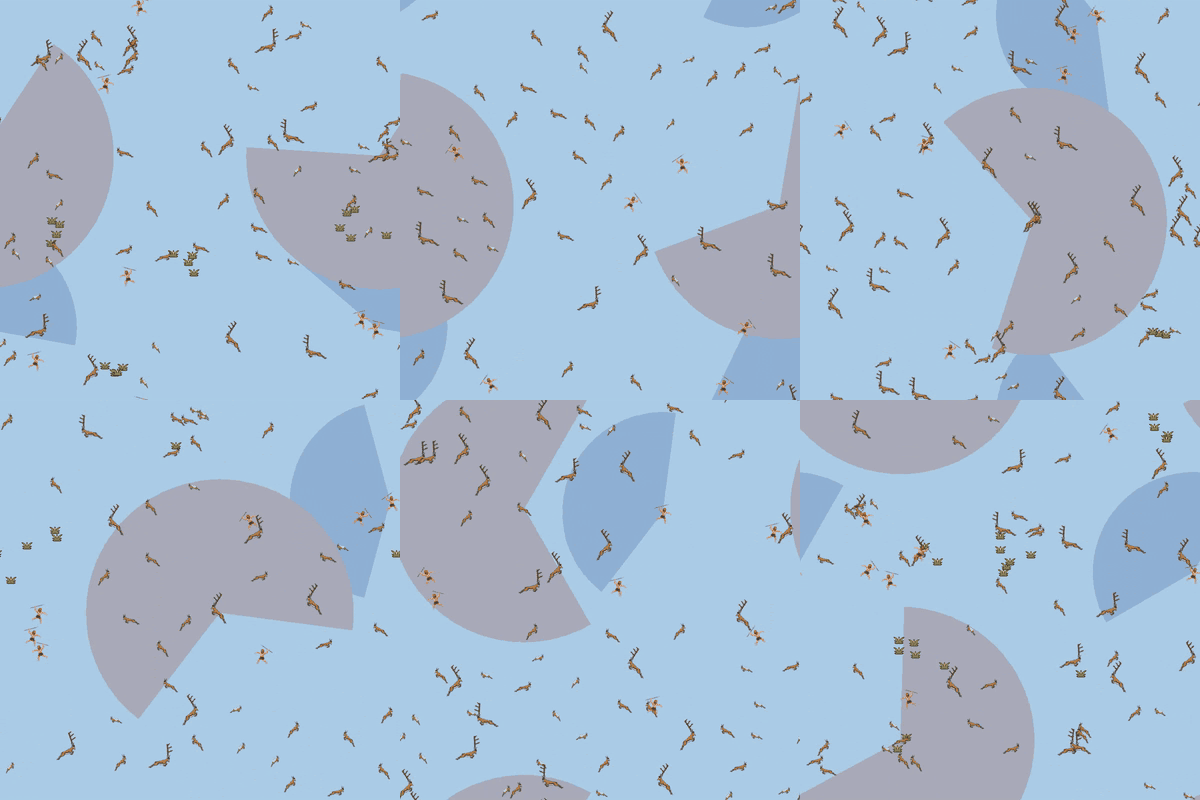
Hunters, standing for humans, and deer share an 800 by 800 continuous torus with clustered grass. Each species learns one shared PPO policy (Schulman et al., 2017), rewarded only for births. Deer eat grass and grow; what a deer is worth, and who can catch it, depends on its energy:
| Deer | Energy | Hunter alone (no other hunter within 64 units) | Another hunter within 64 units of the deer | Stag hunt role |
|---|---|---|---|---|
| Fawn | 2 or less | always caught | always caught, but shared by every hunter within 64 (the others need not touch it) | the hare |
| Middle | between 2 and 5 | caught with a chance falling from 1 to 0 as the deer grows | always caught, shared as for a fawn | in between |
| Adult | 5 or more | never caught | caught only if two or more hunters touch it within one decision (8 physics steps), shared by those who touched it alone | the stag |
The rule for young deer is a sharing rule, kept from the earlier world: a hunter nearby makes the catch certain but takes a share without touching the deer. So the value of a partner grows with the deer's size. Near a fawn a partner costs half the meal; for a middle deer above energy 3.5 a partner gives more in expectation than hunting alone (at energy 4.5, 1.1 each against 0.4 alone); for an adult a partner is required, and the partner has to arrive in time. A lone hunter can live on fawns. The rule makes a partner necessary for an adult, so what is tested is coordination where the task requires two, not the full stag hunt, in which a lone hunter could also take the large prey.
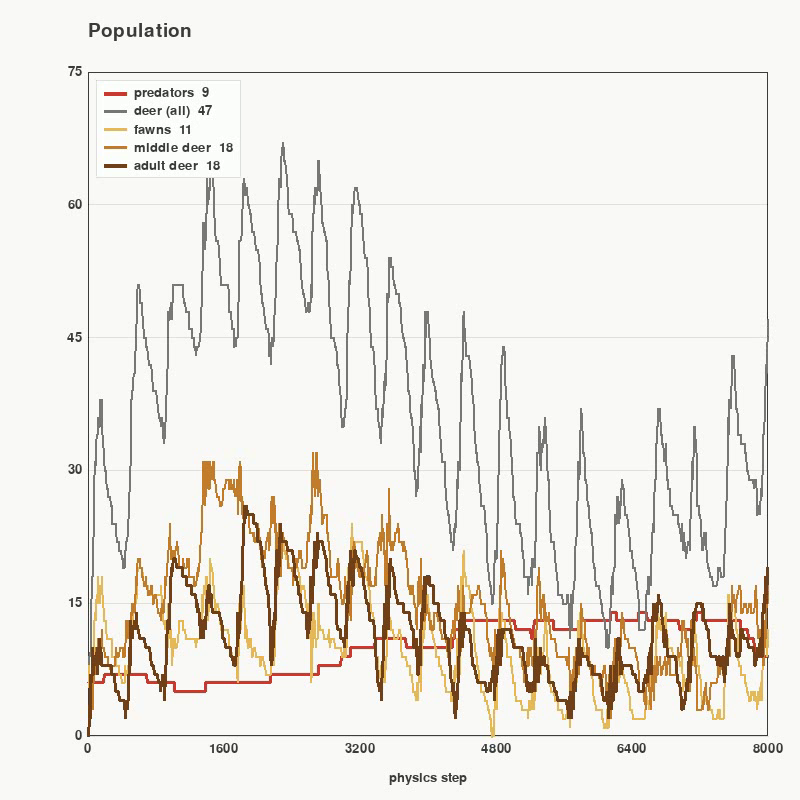
Hunters see up to four other hunters and two deer, with the deer's energy, in a 150° cone of 200 units. Deer see three hunters and three deer in a 240° cone of 267 units, and are faster (top speed 6 against 5). Hunters breed at energy 12 and deer at 7. An episode lasts 8000 physics steps.
What was tested
Three runs (run_1, run_2, run_3) trained from scratch for 1000 iterations each, differing only by chance. Each final checkpoint was tested on:
- Coexistence: hunters and deer both alive at the end of at least 45 of 50 evaluated episodes.
- Cooperation: approaches to adults have another hunter within 64 units more often than approaches to fawns, and more often than chance. Chance is the share of all hunter time spent with another hunter that near (20 evaluated episodes).
- Above the earlier world: adult share divided by chance above 0.90, the value of the stag hunt line's lean-and-fat world, where a fat rabbit needed a party nearby but not two touches.
The tests, the verdict rule and the hard stop (no change to the world after the runs) were written down before training. Checkpoints 250 and 500 were recorded as well, but were not tests.
Results
| Run | Coexisting (of 50) | Chance | Fawn share | Adult share | Adult ÷ chance | Adult − chance, 95% interval | Tests met |
|---|---|---|---|---|---|---|---|
| run_1 | 43 | 0.074 | 0.058 | 0.089 | 1.20 | [0.002, 0.028] | 2, 3 |
| run_2 | 49 | 0.155 | 0.117 | 0.190 | 1.23 | [0.024, 0.045] | 1, 2, 3 |
| run_3 | 50 | 0.125 | 0.095 | 0.144 | 1.15 | [0.010, 0.027] | 1, 2, 3 |
| With calls (earlier, one run) | 49 | 0.132 | 0.155 | 1.18 |
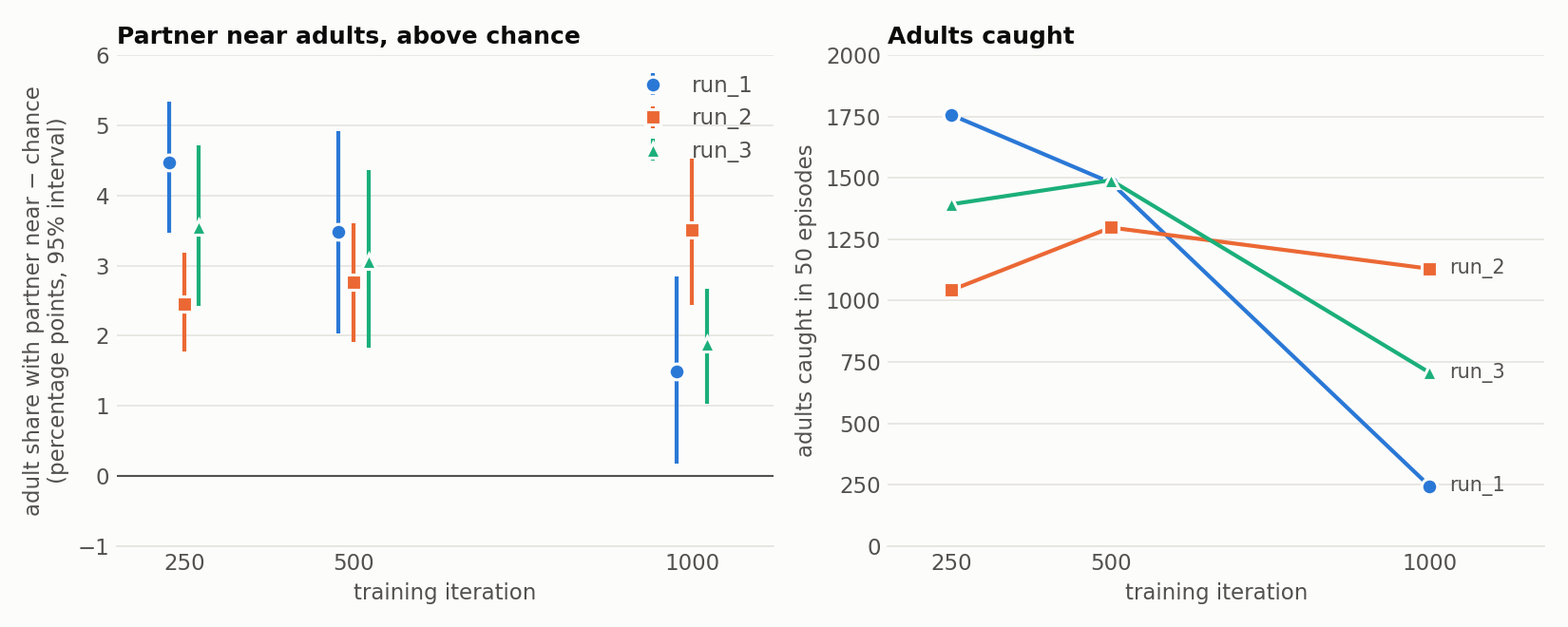
Cooperation above chance was there early and stayed: at iterations 250 and 500 all three runs coexisted in every episode, with adult ÷ chance between 1.17 and 1.25. What changed late was how much hunting of adults there was. In run_1, adult catches fell from 1481 to 243 between iterations 500 and 1000, hunter births fell from 1042 to 439, and 7 episodes lost all hunters; in run_3 adult catches halved. Approaches to adults still had a partner near more often than chance, but there were fewer of them. This experiment did not test why.
Only touching counts
In the world above, a hunter near a young deer shares it without touching it. That rule is not needed for a stag hunt, gives hunters a share for nothing, and builds in part of the fawn comparison. A second experiment, written down before training like the first, changed only that rule:
- every touch is a solo attempt: a fawn is always caught, a middle deer with a chance falling from 1 at energy 2 to 0 at energy 5, an adult never; the catch goes to the toucher alone;
- two or more hunters touching a deer within one decision catch it whatever its size, and share it between them only;
- a hunter merely near gets nothing.
| Deer | Energy | One hunter touches it | Two or more hunters touch it within one decision | A hunter near but not touching |
|---|---|---|---|---|
| Fawn | 2 or less | always caught, all for the toucher | caught, shared by the touchers | gets nothing |
| Middle | between 2 and 5 | caught with a chance falling from 1 to 0 as the deer grows, all for the toucher | caught, shared by the touchers | gets nothing |
| Adult | 5 or more | never caught | caught, shared by the touchers | gets nothing |
Adults are caught exactly as before. Three new runs (touch_1, touch_2, touch_3) were trained from scratch and tested as before, with the same verdict rule and the same hard stop. The cooperation tests kept the same measure too: an approach with another hunter within 64 units of the deer. Under the touch rule that distance plays no part in catching; it measures only where the hunters are, and was kept so that the two experiments compare directly. The measure that fits the touch rule, two hunters touching the deer together, comes in the next part.
| Run | Coexisting (of 50) | Chance | Fawn share | Adult share | Adult ÷ chance | Adult − chance, 95% interval | Tests met |
|---|---|---|---|---|---|---|---|
| touch_1 | 50 | 0.132 | 0.093 | 0.148 | 1.12 | [0.006, 0.026] | 1, 2, 3 |
| touch_2 | 50 | 0.142 | 0.099 | 0.171 | 1.21 | [0.023, 0.036] | 1, 2, 3 |
| touch_3 | 50 | 0.082 | 0.054 | 0.095 | 1.15 | [0.004, 0.021] | 1, 2, 3 |
So the sharing rule for young deer was not needed for this result. The limits carry over: adults were 1.5 to 3.2% of the deer caught, and adult catches again fell between iterations 500 and 1000, by 25 to 44%, though no run lost its hunters.
Pairing where a partner pays but is not required
Under the touch rule, a middle deer is a small stag hunt of its own. A hunter can try it alone and catch it with a chance that falls as the deer grows, or two hunters can take it for certain and split it. Per hunter, alone pays more below energy 3.5 and a partner pays more above it. Nothing forces a partner, so this is the stag hunt in its strict sense, which no earlier world of this line had shown.
After a first look at earlier checkpoints of touch_1 and touch_2, three tests were written down before the final checkpoints existed. In each run: (A) the share of approaches with a partner near rises from middle deer of energy 2 to 3.5 to those of energy 4 to 5; (B) for the largest middle deer (energy 4.5 to 5) it is above chance; (C) two hunters touch middle deer of energy 4 to 5 together at least half as often as they do adults. The pattern counts as shown if all three hold in at least 2 of the 3 runs.
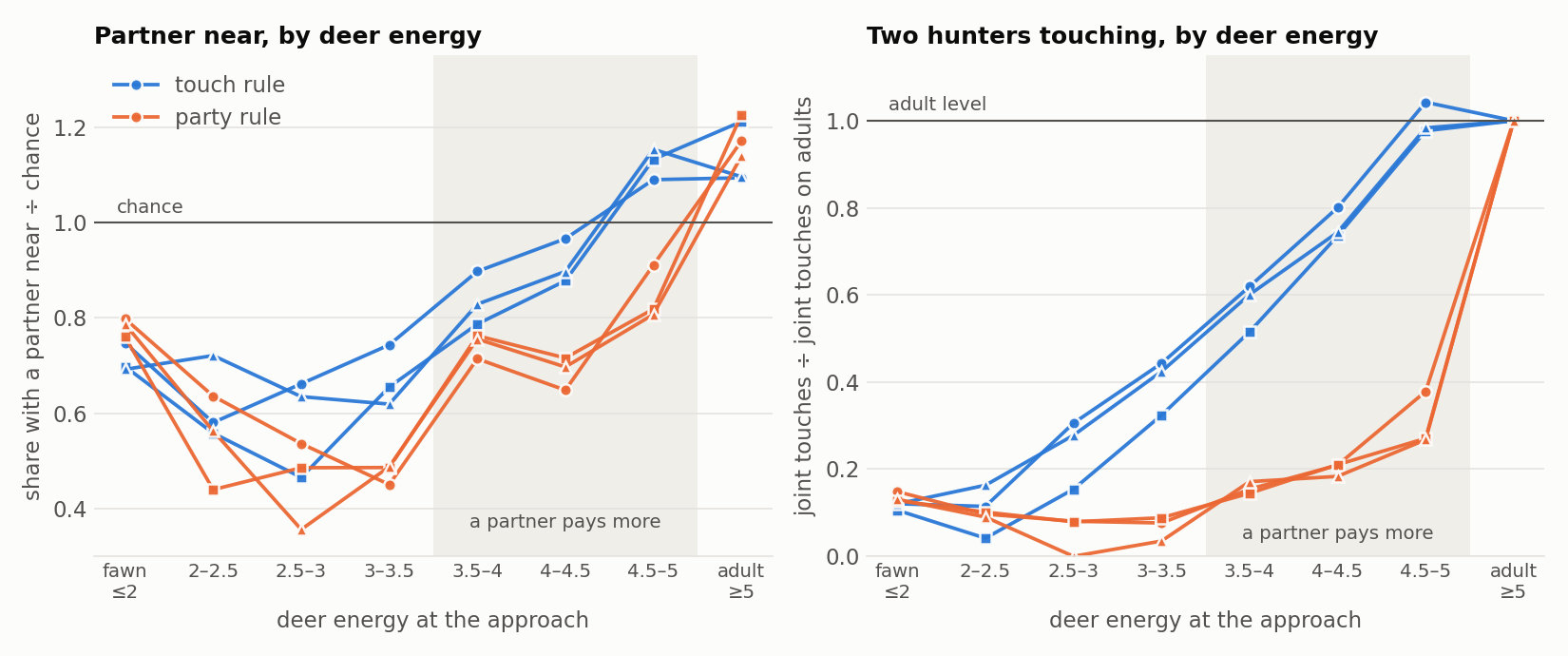
Verdict: pattern shown. touch_2 and touch_3 met all three tests; touch_1 met A and C and missed B narrowly (its 95% interval for near share minus chance was −0.001 to +0.025). touch_3, the one run nobody had looked at before the tests were set, met all three. Under the original rule all three runs failed B and C: there the largest middle deer stayed below chance, and joint touches on them were about a quarter of the adult level.
This is consistent with hunters pairing up where a partner pays without being required. It is not proof of choosing by payoff. The crossing of chance comes near energy 4.5, not at the break-even of 3.5. Large middle deer differ from adults only by a little energy, so they may share places with adults, or hunters may simply treat them like adults; a joint-touch level close to the adult one would look the same either way. A control world separates these explanations (next part).
A control world: when a partner never pays
To tell payoff apart from place and looks, three more runs (control_1 to control_3, 500 iterations) were trained in the touch world with one change, set in advance: one hunter catches any fawn or middle deer for certain. Adults still need two. A partner now never pays for a young deer, since sharing only halves a meal that is certain anyway, but the deer stand where they stood and look as they looked. If payoff drove the pairing on large middle deer, it should vanish here; if place or likeness to adults drove it, it should stay. The rule: payoff is supported if, in at least 2 of 3 runs that keep hunters and deer together (45 of 50 episodes or more), test B fails and joint touches on deer of energy 4 to 5 stay clearly below half the adult level.
| Run | Coexisting (of 50) | Partner near, energy 4.5 to 5, ÷ chance | B: near − chance, 95% interval | C: joint (4 to 5) ÷ joint adult, 95% interval |
|---|---|---|---|---|
| control_1 | 48 | 0.94 | [−0.026, +0.001] | 0.31 [0.27, 0.35] |
| control_2 | 49 | 0.90 | [−0.036, −0.007] | 0.28 [0.24, 0.32] |
| control_3 | 49 | 0.86 | [−0.043, −0.013] | 0.28 [0.23, 0.32] |
| touch_1, iteration 500 | 50 | 1.18 | [+0.017, +0.039] | 1.00 [0.91, 1.11] |
| touch_2, iteration 500 | 50 | 1.13 | [+0.011, +0.032] | 0.89 [0.82, 0.97] |
| touch_3, iteration 500 | 50 | 1.04 | [−0.005, +0.013] | 0.84 [0.76, 0.93] |
Verdict: payoff supported. Without a payoff for a partner, hunters stayed just below chance with the largest middle deer, and teamed up on them less than a third as often as on adults, much as in the original world. So place and likeness to adults did not by themselves produce the pairing seen under the touch rule; the result is consistent with hunters pairing up more where a partner pays.
It has limits. Partnering still rose with the deer's size in the control world, even more steeply, so place or likeness may explain part of that rise; what the control lacks is the step from just below chance to above it. Hunters teamed up on adults more often in the control world, which lowers the ratio in test C from the adult side too, so test B is the cleaner comparison. The two worlds also differ in food: easy catches feed the hunters more, and they stood closer together. The verdict rests on the pattern being absent in one world, not on a direct test of the difference, and the margins are a few percentage points.
Two follow-ups: instincts and sharing
Two experiments built on the touch world, each pre-registered with a hard stop. Neither met its main test.
Inherited instincts plus learning. In the eco_evolutionary_deer_stag_hunt module every hunter carries inherited pulls towards or away from other hunters, young deer and adult deer, passed to its offspring with small mutations. In six runs (arm B) these pulls steer behaviour on top of the shared learned policy; in six others (arm L) hunters carry them but they do nothing. The deer learn alongside the hunters in every run. Each run's hunters were tested against the deer of the eleven other runs, so that no run wins by having easy deer.
| Arm | Adults caught per episode | Success per adult attempt | Partner near adults ÷ chance | Evolved pull: young deer / adults |
|---|---|---|---|---|
| L: learning only (6 runs) | 18.6 | 0.020 | 1.08 to 1.16 | drift, both directions |
| B: learning plus instincts (6 runs) | 14.2 | 0.023 | 0.83 to 0.93 | +0.9 / −0.8 in every run |
Where the instincts acted, evolution moved them the same way in all six runs: strongly towards young deer, which a hunter catches alone, and away from adults, which need two. Those hunters approached adults with a partner near less often than chance, while learning alone stayed above it. This looks like the stag hunt's familiar outcome, selection favouring the safe option over the risky joint one, but it is a reading, not a tested claim: the two arms differ in their whole history, including their deer. A pre-registered follow-up then switched the instincts off in the trained B hunters, keeping everything else the same. Their approaches to adults with a partner near rose from below chance to above it in all six runs, above every L run against the same deer. But they caught fewer adults, fed and bred less, and in some runs often died out. So the learned policy relied on the instincts to find food, and no better cooperative strategy appeared beneath them. The instincts and the learned policy pulled partnering in opposite directions, and the instincts won; the hypothesis that learning had built a more successful cooperative strategy underneath was not supported.
Sharing big game. In the deer_food_sharing module the catchers of an adult keep half, and the other half goes to every hunter within 128 units, as human foragers share large game widely. Three runs coexisted in 50 of 50 episodes, but approached adults with a partner near 1.04 to 1.12 times chance, not above the three touch runs (1.12 to 1.21), and caught no more adults. A theory model predicted this before training: sharing with everyone nearby is a transfer to free-riders, and sharing only among hunters of big game helps only when big game pays clearly more than the alternative, 1.2 to 1.75 times at the deer world's success rates. Field data on hunter-gatherers do not clearly show big game paying that much more. By the rule set in advance, the sharing line ends here.
Selection between groups. The textbook answer to a stag hunt is that groups which settle on the joint hunt outgrow or replace groups that do not. Before building it into the deer world, a theory screen tested it in the same stag hunt model, with 14 groups and two rules: the worst group replaced by a copy of the best, or a growing group splitting into a weaker neighbour. Neither let stag hunting take over, at any payoff ratio up to 1.75. The reason is arithmetic: when a hunt that needs two often fails and a missed meal costs more than a big one gains, even a group of only stag hunters is less fit than a group of hare hunters, so selection between groups has nothing to favour. Pooling the catch within the group would remove that cost; the two together were not tested. By the rule set in advance, this line too ends at the screen.
What this does and does not show
Within this world, hunters learned to approach the prey that needs two with another hunter nearby more often than chance, in three runs out of three, and calls were not needed for it. The result held again, in three runs out of three, when only touching counts. That makes this the one replicated cooperation result in the stag hunt line.
It has clear limits:
- For adults, a partner is required by rule. The main result is coordination where the task demands two, not the stag hunt in its strict sense, where hunters choose a partner for a bigger share although alone they could also succeed. The pairing on large middle deer under the touch rule is the first sign of that version in this line, but it is small and its tests were informed by a look at earlier checkpoints. A control world without a payoff for a partner did not show it, which points to the payoff rather than to place or likeness to adults, though the worlds also differ in ecology.
- The measure is an approach with a partner near, not proof that hunters seek a partner. Hunters may meet near adults for other reasons, such as shared grass areas or deer herds; the chance baseline removes only part of that.
- The fawn comparison is partly built in. A partner near a fawn takes half of it, so hunters have a reason to keep away from others near fawns, which lowers the fawn share. The comparison with chance does not have this bias, and adults were above chance in all three runs, but part of the gap between adults and fawns may come from avoiding sharing rather than seeking partners. Under the touch rule a partner near a fawn takes nothing, and adults were still above fawns in all three runs.
- The effect is small and fragile. Adults stayed a small part of the hunters' diet, and in two runs catching them declined late in training.
- Three runs show variation, not a population estimate. Learning is one PPO policy shared by all hunters, not individual learning within a lifetime.
References
- Skyrms, B. (2004). The stag hunt and the evolution of social structure. Cambridge University Press. https://doi.org/10.1017/CBO9781139165228
- Schulman, J., Wolski, F., Dhariwal, P., Radford, A., & Klimov, O. (2017). Proximal policy optimization algorithms. arXiv:1707.06347. https://arxiv.org/abs/1707.06347
- Hawkes, K., O'Connell, J. F., & Blurton Jones, N. G. (2014). More lessons from the Hadza about men's work. https://content.csbs.utah.edu/~hawkes/HawkesOConnellBLurtonJones14moreLessonsHadzaHunters.pdf
- doesburg11. PredPreyGrass,
eco_evolutionary_deer_stag_huntanddeer_food_sharingmodules (RESULTS.md, sections 3.8 and 1.6). GitHub. - doesburg11. EvolvedCooperation,
ecological_models/stag_hunt_sharing(theory model of shared big game). GitHub. https://github.com/doesburg11/EvolvedCooperation/tree/main/ecological_models/stag_hunt_sharing - doesburg11. PredPreyGrass,
deer_stag_huntmodule (code, pre-registration and results). GitHub. https://github.com/doesburg11/PredPreyGrass/tree/main/predpreygrass/non_evolutionary/continuous_space/deer_stag_hunt