Cooperation in Perspective
The front page asks how cooperation emerges from evolution and learning. This page asks a different question: where cooperation belongs within the broader map of human behavior. It therefore focuses mainly on conceptual placement rather than on retelling the full nature-and-nurture story.
Cooperation should not be treated as an isolated topic. It is one of the major relational modes through which people coordinate, accommodate, support, teach, regulate, and live with one another. To understand what cooperation is, it helps to place it alongside adversarial behavior and alongside the smaller remainder of interaction that is neither clearly cooperative nor clearly adversarial.
Where Cooperation Fits in Human Behavior
Before focusing on cooperation itself, it helps to clarify the broader frame. Human behavior is the broad spectrum of observable responses through which individuals adapt to internal states, other people, and the environment. For the purposes of this site, the emphasis is on behavior that is available to ordinary social perception: what people can see, hear, or otherwise detect in one another without specialized instruments. That is the practical level at which coordination, accommodation, rivalry, and conflict become socially meaningful.
The fuller definition of broad cooperation is developed in What is Cooperation?. The adversarial side of the same interaction space is developed in What is Adversarial Behavior?.
Why behavior is needed at all
Before classifying behavior, it helps to ask what behavior is for. Maslow's hierarchy of needs offers one useful ordering: physiological survival needs sit at the base, and only once they are met does behavior tend to climb toward social needs such as belonging, esteem, and cooperation with others, as shown in Display 1.
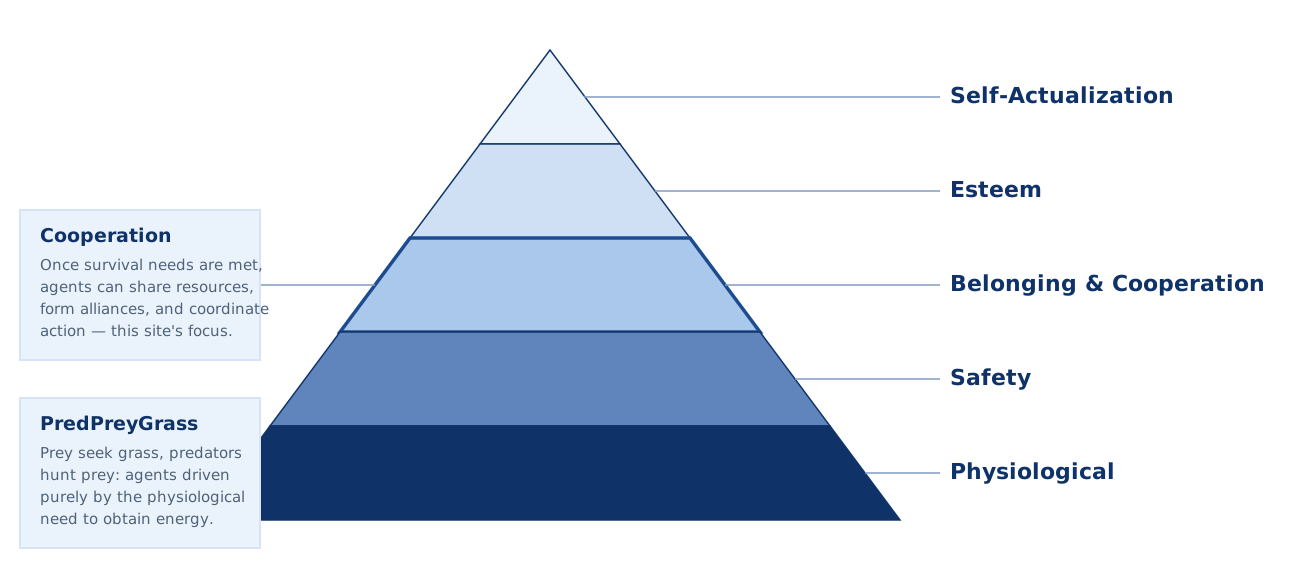
This project's PredPreyGrass simulations give a concrete, minimal illustration of the base of that hierarchy. Predators, prey, and grass are agents driven purely by the need to obtain energy: prey must find and consume grass, predators must hunt prey, and agents that fail to meet that physiological need perish. Nothing resembling cooperation is possible before that layer is secured. Once survival pressure eases, the same kind of multi-agent system can start to show agents forming alliances, sharing resources, or coordinating action — the belonging layer of the hierarchy, and the layer this site's broader cooperation research focuses on.
Needs-based framings like this are a complement to, not a replacement for, the two-timescale (nature and nurture) account developed on the front page: the hierarchy explains why cooperative behavior tends to appear only once survival is not in question, while nature and nurture explain how cooperative capacities are built and expressed.
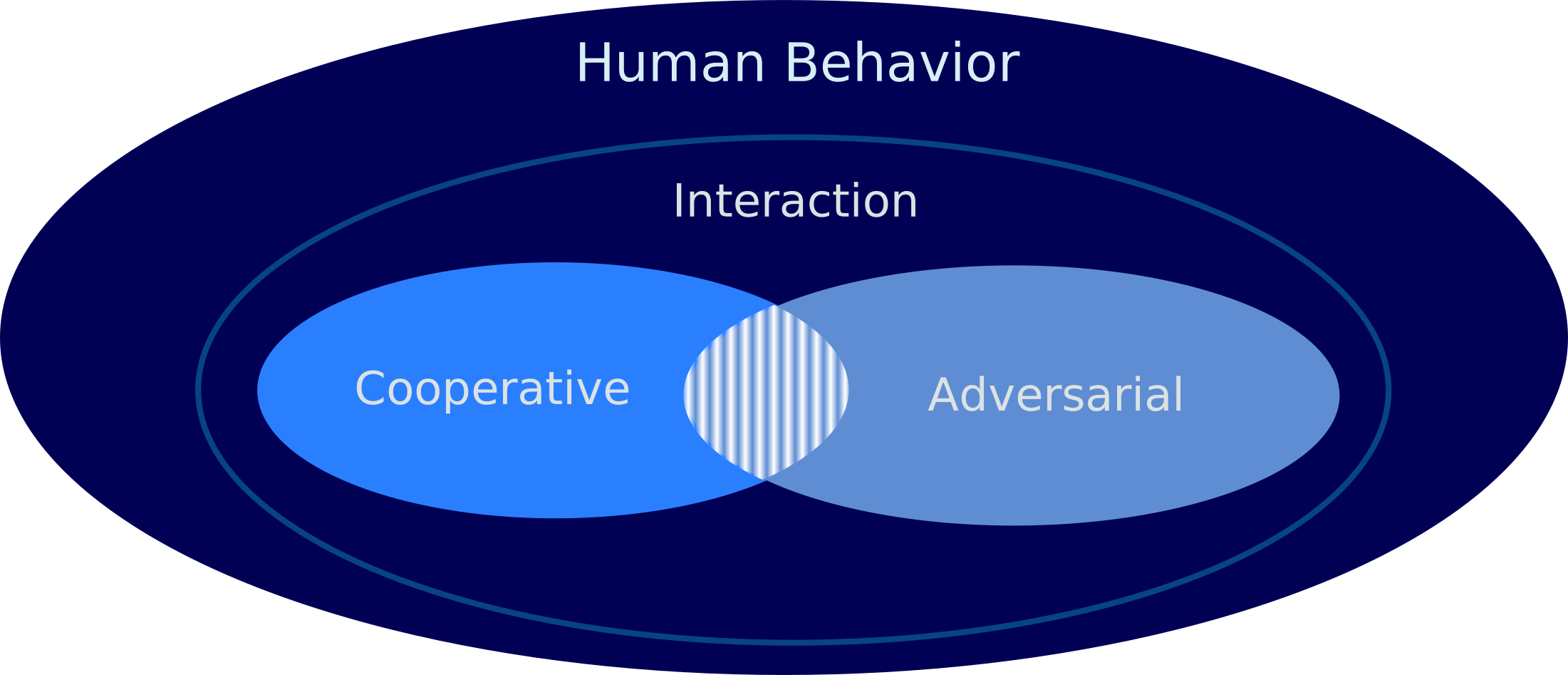
Within the broad domain of human behavior, a major subset is human interaction: behavior in which people orient to, respond to, influence, or regulate one another. Within this interactive domain, cooperation is best viewed alongside adversarial interaction rather than as a stand-alone phenomenon.
In this broad sense, cooperation includes not only explicit teamwork or collective action, but also many everyday forms of mutual accommodation: helping, sharing, teaching, caregiving, turn-taking, politeness, tacit coordination, and routine civility. At the same time, not all interaction is cooperative. Human interaction can also be adversarial, including both competition, where actors rival one another for scarce goods, status, or advantage, and conflict, where interaction takes the form of more direct opposition, resistance, or obstruction.
These modes are not clean opposites. People may cooperate internally in order to compete externally, as in team sports, business organizations, political coalitions, or military groups. Conflict can also serve cooperation, for example when free riders are punished to protect collective norms. Cooperation is therefore best understood not as the absence of conflict or competition, but as one side of a broader interactive landscape shaped by both compatible and incompatible interdependence.
Display 2 is therefore best read as a broad orientation map rather than as a final taxonomy. The cooperative side can be subdivided into mutual accommodation, active support, shared coordination, and norm-sustaining cooperation. The adversarial side can be subdivided into competition, conflict, coercion or domination, and exploitation or sabotage. The overlap region includes cases where those modes are combined in the same social system.
| Region in Display 2 | Useful subdivisions | Typical examples |
|---|---|---|
| Cooperative | mutual accommodation; active support; shared coordination; norm-sustaining cooperation | turn-taking, helping, caregiving, teaching, teamwork, division of labor, civility, rule-following |
| Adversarial | competition; conflict; coercion or domination; exploitation or sabotage | status rivalry, market competition, direct obstruction, protest, threat, forced compliance, undermining opponents |
| Mixed or overlapping | cooperation inside competition; conflict defending cooperation; institutionalized rivalry | sports teams, firms, political parties, sanctions against free riders, courts, elections, regulated markets |
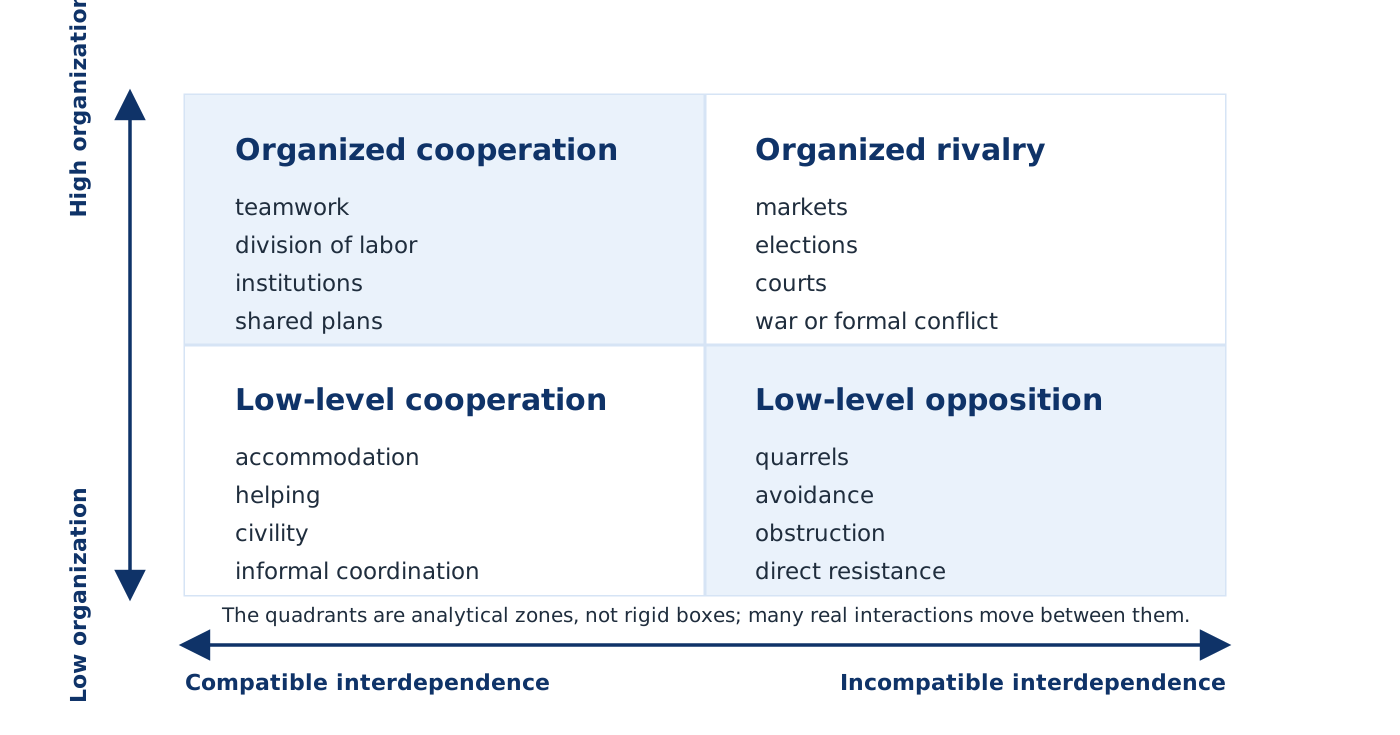
Another way to sharpen the same distinction is to classify interaction by two axes: whether the relation is based mainly on compatible or incompatible interdependence, and whether it is loosely organized or highly organized.
Overlap between cooperation and adversarial behavior
Cooperative and adversarial behavior can overlap rather than excluding one another cleanly.
A compact way to summarize the main overlap patterns is the following:
| Pattern | How the overlap works | Examples |
|---|---|---|
| Internal cooperation for external rivalry | Actors cooperate within a group in order to compete or conflict with another group. | team sports, firms facing rivals, political coalitions, military units |
| Adversarial enforcement of cooperation | Opposition, punishment, or sanctioning is used to protect a cooperative norm or arrangement. | punishing free riders, confronting cheats, sanctioning rule-breakers, enforcing collaboration norms |
| Mixed or intertwined settings | Cooperative and adversarial relations operate together in the same social system rather than appearing separately. | party politics, labor strikes, courtroom settings, team sports, war coalitions |
Interaction outside cooperative and adversarial behavior
If cooperation is interpreted broadly, then much ordinary interaction is already absorbed into cooperation. That means the region of human interaction strictly outside both cooperative and adversarial behavior becomes smaller.
Still, some interaction remains outside both. The clearest cases are forms of social perception and mere expression that are socially oriented but not yet organized as either accommodation or opposition: noticing that someone looks anxious, making brief eye contact, watching another person's expression, blushing, nervous laughter, or tone of voice as an expressive cue. These cases involve social orientation, but they do not by themselves facilitate another person's action and they are not adversarial. A more borderline remainder consists of authority and hierarchy, such as a judge addressing a defendant, a security guard directing visitors, or a supervisor issuing routine instructions. These cases should be classified contextually rather than automatically placed outside both, because some are cooperative, some adversarial, and some remain mainly formal or procedural.
A compact taxonomy
| Dimension | Broad cooperation | Adversarial | Outside both |
|---|---|---|---|
| Core relation | Compatibility, accommodation, support, or orderly coordination | Rivalry, opposition, obstruction, or negative interdependence | Social orientation without either accommodation or opposition |
| Typical forms | helping, teaching, turn-taking, civility, tacit coordination | competition, conflict, coercion, sabotage, punishment | social perception, mere expression, some formal hierarchy |
| Interpretive note | Includes much ordinary interaction under a broad definition | Can overlap with cooperation in mixed or strategic settings | Small residual category; authority cases are often borderline |
Borderline cases such as greeting, small talk, turn-taking, and authority should therefore be classified contextually. In most ordinary settings, greeting, small talk, and turn-taking belong inside broad cooperation because they sustain civility and mutual accommodation. Authority relations vary more sharply by context: some are cooperative, some adversarial, and some remain mainly formal rather than clearly either.
What this means for the diagram
A useful interpretation of the diagram is the following:
- Human Behavior is the largest domain.
- Human Interaction is a subset of human behavior.
- Within human interaction, cooperative and adversarial behavior are two major and overlapping relational modes.
- Competition and conflict are major forms of adversarial behavior.
- The remaining area of human interaction outside those two is relatively small, and is best reserved for social perception, mere expression, and authority or hierarchy not yet clearly cooperative or adversarial.
This prevents the outside region from being overloaded with examples that actually belong inside broad cooperation.
Concise conceptual summary
Human interaction is broader than cooperative and adversarial behavior, but these two categories capture many of its most important relational modes. If cooperation is understood broadly, it includes not only explicit teamwork but also helping, civility, tacit coordination, turn-taking, and routine social accommodation. Adversarial behavior includes both competition and conflict. Under that broad definition, much everyday interaction falls within cooperation rather than outside it. What remains outside cooperative and adversarial behavior consists mainly of social perception, expressive signaling, and some hierarchical relations that are not yet cooperative or adversarial.
Why Cooperation Matters Especially for Humans
The front page explains cooperation as a two-timescale problem shaped by evolution and learning. This page does not repeat that full argument, but it does clarify why cooperation deserves such a central place in it. Human life is deeply structured by interdependence, so any account of behavior has to explain how people become able to coordinate, accommodate, and learn from one another.
Herrmann et al. (2007) help make that point more precise. The comparison with closely related ape species suggests that the human difference is especially large in the social domain rather than across every kind of problem-solving.
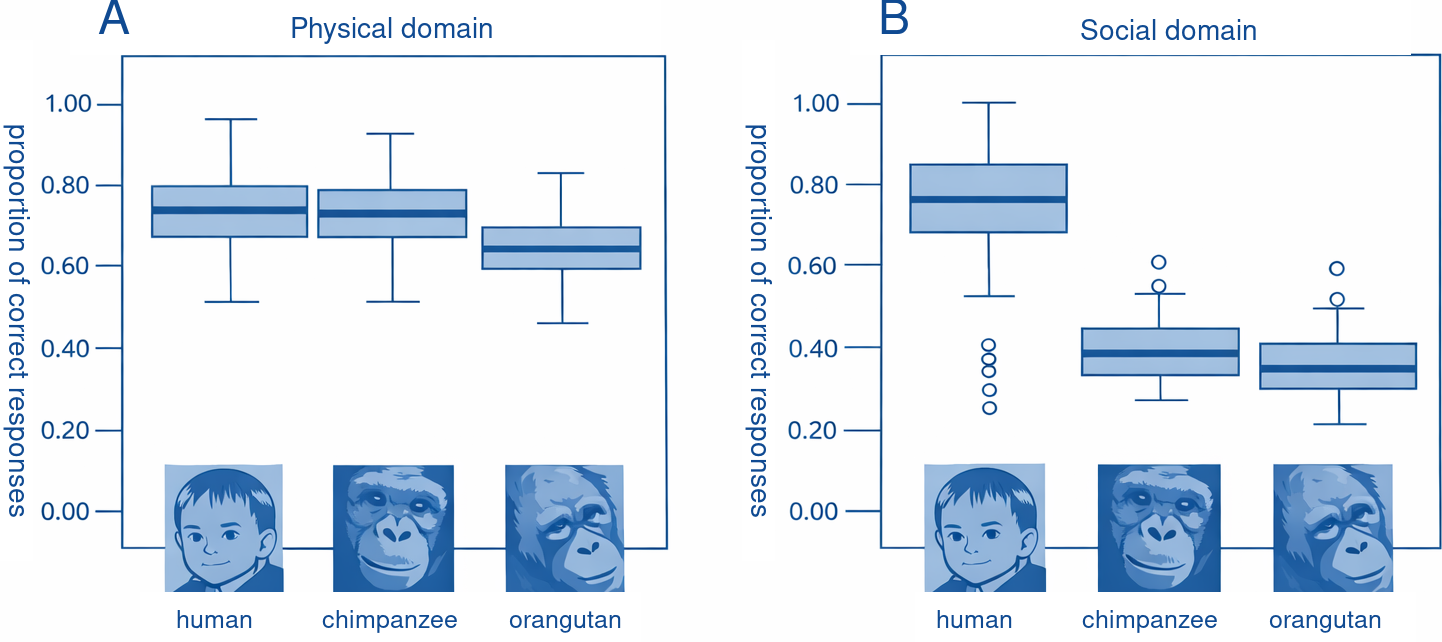
The point is not that humans are superior at everything. The more relevant claim for this site is that humans show an early advantage in social cognition: attending to others, inferring goals, coordinating attention, and learning from social interaction. Those capacities do not amount to a fixed cooperative script, but they do provide part of the inherited background that makes cooperation developmentally and behaviorally possible.
An influential line of work associated with Dunbar's social brain hypothesis makes a related point from the evolutionary side. In Dunbar's formulation, a substantial part of primate brain expansion is connected to the demands of social life rather than to solitary problem-solving alone. The exact strength of that claim can be debated, but the broader implication is clear enough for the present page. If social life imposed heavy demands on coordination, communication, and relationship management, then selection would be expected to favor capacities that support socially responsive behavior.
On that view, cooperation is not an isolated add-on to human life. It is one expression of a broader system in which inherited social capacities and lifetime learning jointly shape how people interact.
Fast and slow paths to a cooperative decision
Capacity is not the same as mechanism: knowing that humans are unusually well equipped for social cognition still leaves open how any single cooperative decision actually gets made. LeDoux's dual-pathway model of threat and stimulus processing offers one well-studied account, as shown in Display 8 (LeDoux, 1996, 2000). A "low road" pathway routes sensory input directly from the thalamus to the amygdala, producing a fast, largely automatic appraisal before slower reasoning has time to engage. A "high road" pathway routes the same input through sensory cortex first, allowing more detailed evaluation — slower, but better informed — before it also reaches the amygdala. A third, faster system exists alongside both: simple spinal reflexes, such as the knee-jerk response, bypass the brain entirely and never reach the thalamus at all, so they are not a third branch of this circuit but a separate system (Kandel et al., 2013). A reflex is, in any case, not itself an emotion (Lazarus, 1991).
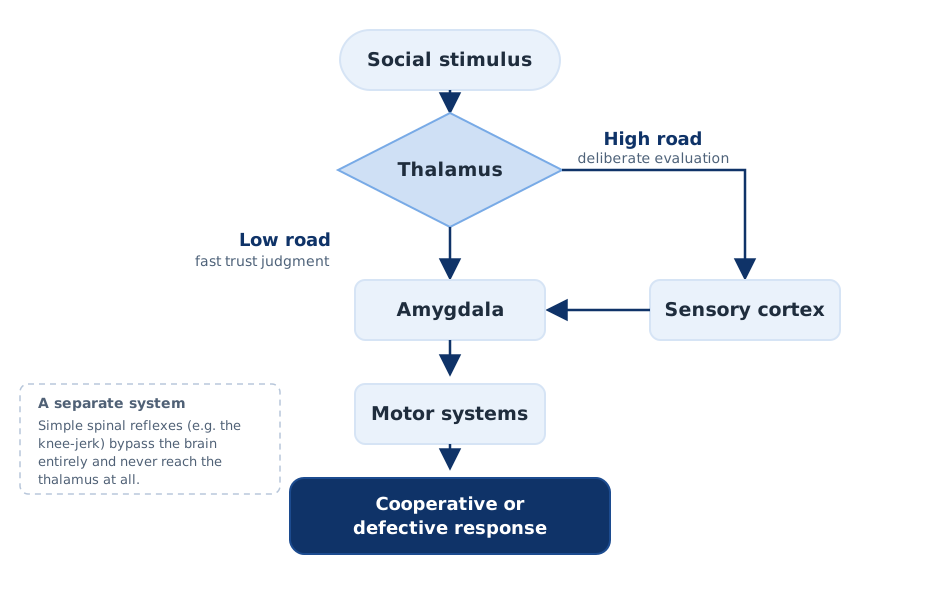
This distinction matters directly for cooperation. It parallels a broader dual-process account of judgment and decision-making — Kahneman's (2011) distinction between fast, intuitive "System 1" thinking and slower, effortful "System 2" reasoning — applied specifically to cooperative choice. Using that same dual-process framework, Rand, Greene, and Nowak (2012) found that in one-shot economic games, intuitive, time-pressured responses tended to favor cooperation, while giving people more time to deliberate shifted behavior toward self-interested calculation — a pattern they summarized as "spontaneous giving and calculated greed." The direction of the effect is not fixed; later work shows it depends on what a person's environment has reinforced as the default response. What the finding does establish is that cooperative behavior is not produced by a single decision process. A fast, low-road trust judgment and a slower, high-road reciprocity calculation can arrive at different answers to the same interaction, and an account of cooperation has to accommodate both.
The low-road trust judgment is not just fast; it is also biologically tunable. Kosfeld, Heinrichs, Zak, Fischbacher, and Fehr (2005) found that intranasally administered oxytocin substantially increased trust behavior in an economic trust game — and that the effect was specific to trust in another person, not to risk tolerance more generally. Oxytocin does not decide whether a person cooperates, but it is one concrete mechanism through which the amygdala-based low road can be tuned toward or away from trusting another person before slower reasoning has a chance to weigh in.
Why cooperation needs an internal enforcer, not just external ones
Most of the mechanisms discussed on this site — reciprocity, reputation, punishment, kin selection — work by making defection costly through some external channel: a partner who stops cooperating, a community that notices, a relative who shares your genes. Frank (1988) makes the case for a complementary mechanism that requires no external observer at all: emotions such as guilt, shame, and moral anger function as commitment devices, internal signals that make cooperative or vengeful behavior credible even when it isn't, in the moment, in a person's narrow self-interest. A person disposed to feel guilt about cheating a trusting partner is more trustworthy precisely because that guilt is hard to fake convincingly — which is what makes it a credible signal to others in the first place, not just a private cost. This is why cooperation can persist even under conditions where external enforcement is absent, unlikely, or delayed: the enforcement has been moved inside the agent, where it no longer depends on being caught.
What follows
For a more explicit definition of the cooperative side, see What is Cooperation?. For the opposing side of the same broader interaction space, see What is Adversarial Behavior?. For the two-timescale explanation of how cooperation emerges through evolution and learning, return to The Nature and Nurture of Cooperation and Competition.
References
- Herrmann, E., Call, J., Hernández-Lloreda, M. V., Hare, B., & Tomasello, M. (2007). Humans Have Evolved Specialized Skills of Social Cognition: The Cultural Intelligence Hypothesis. Science, 317(5843), 1360-1366. https://doi.org/10.1126/science.1146282
- Dunbar, R. I. M. (1992). Neocortex size as a constraint on group size in primates. Journal of Human Evolution, 22(6), 469-493.
- Dunbar, R. I. M. (1998). The social brain hypothesis. Evolutionary Anthropology, 6(5), 178-190.
- Frank, R. H. (1988). Passions Within Reason: The Strategic Role of the Emotions. New York: W. W. Norton & Company.
- LeDoux, J. E. (1996). The Emotional Brain: The Mysterious Underpinnings of Emotional Life. New York: Simon & Schuster.
- LeDoux, J. E. (2000). Emotion circuits in the brain. Annual Review of Neuroscience, 23, 155-184. https://doi.org/10.1146/annurev.neuro.23.1.155
- Kandel, E. R., Schwartz, J. H., Jessell, T. M., Siegelbaum, S. A., & Hudspeth, A. J. (2013). Principles of Neural Science (5th ed.). New York: McGraw-Hill.
- Kahneman, D. (2011). Thinking, Fast and Slow. New York: Farrar, Straus and Giroux.
- Kosfeld, M., Heinrichs, M., Zak, P. J., Fischbacher, U., & Fehr, E. (2005). Oxytocin increases trust in humans. Nature, 435(7042), 673-676. https://doi.org/10.1038/nature03701
- Lazarus, R. S. (1991). Emotion and Adaptation. New York: Oxford University Press.
- Rand, D. G., Greene, J. D., & Nowak, M. A. (2012). Spontaneous giving and calculated greed. Nature, 489(7416), 427-430. https://doi.org/10.1038/nature11467