Experiment - Network Diversity
This is not a new model — no new agent architecture is introduced. It takes all three existing models and runs them under systematically varied network conditions via experiment_network_diversity.py, testing when simple partner-memory mechanisms stop being sufficient and social infrastructure mechanisms start to dominate.
Key findings
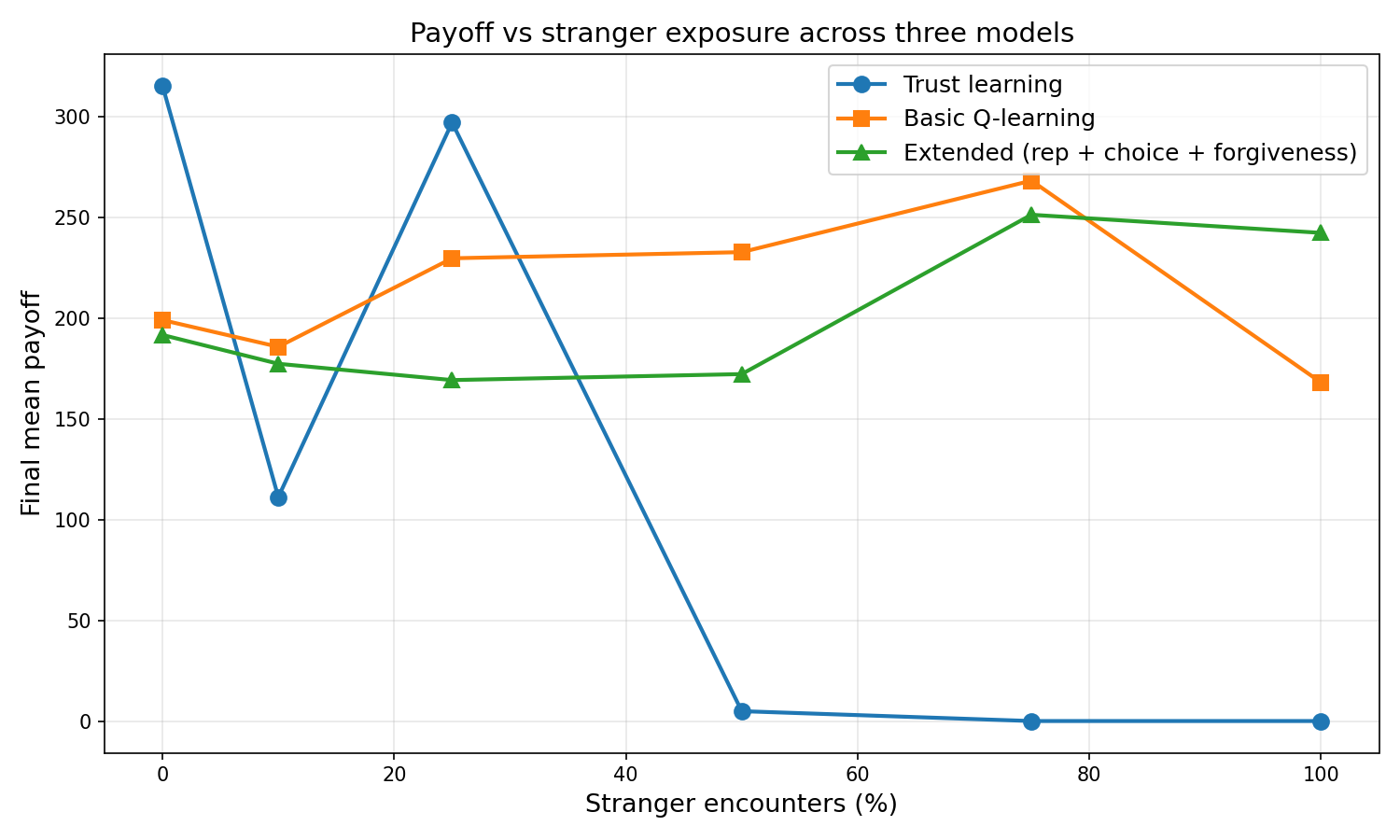
- Trust learning collapses completely at high stranger exposure (0.0 payoff at 75–100% strangers) — without repeated contact it has nothing to learn.
- Q-learning is robust at intermediate stranger fractions (peak payoff 268 at 75%) but drops back at 100%.
- The extended model is the only one that holds payoff above 240 at 100% strangers — reputation provides an effective prior for first encounters with unknown partners.
- Crossover is between 50% and 75% stranger encounters. Below that, trust learning with its simpler mechanism can win; above that, social infrastructure becomes indispensable.
- This mirrors the transition in human evolutionary history from small stable bands (direct reciprocity suffices) to anonymous market societies (reputation systems required).
Hypothesis
In stable local neighborhoods, personal experience should be enough for cooperation. As stranger_fraction increases, reputation and partner choice should become more important, and the extended model should outperform simpler models.
Design
The manipulated variable is stranger_fraction: the probability that each interaction slot is filled by a randomly chosen agent rather than the fixed ring neighbor.
| Condition | Meaning |
|---|---|
| 0% | Pure ring: same local neighbors every round |
| 50% | Half local, half strangers |
| 100% | Fully anonymous — every interaction is with a stranger |
Results
| Stranger fraction | Trust learning | Q-learning | Extended |
|---|---|---|---|
| 0% | 315.7 | 199.2 | 191.8 |
| 10% | 111.2 | 185.9 | 177.4 |
| 25% | 297.3 | 229.8 | 169.3 |
| 50% | 4.9 | 232.9 | 172.3 |
| 75% | 0.0 | 268.4 | 251.5 |
| 100% | 0.0 | 168.1 | 242.5 |
Summary
Trust learning collapses completely at high stranger exposure (0.0 payoff at 75–100%). Without repeated contact with the same partners, agents cannot build the personal trust that drives cooperation. In a fully anonymous market, trust learning is helpless.
Q-learning is robust at intermediate stranger fractions (peak 268 at 75%), but drops back at 100%. Q-learning agents exploit the discount factor well when they meet a mix of regulars and strangers, but in a fully random environment they can't build partner-specific Q-histories either.
The extended model is the only one that holds payoff above 240 at 100% strangers. Reputation provides an effective prior for unknown partners — agents cooperate with well-reputed strangers and exclude poorly-reputed ones before any personal interaction. Partner choice is actionable because reputation travels ahead of the agent. This is exactly the mechanism that allows humans to trade with, lend to, and cooperate with people they have never met.
The crossover point is between 50% and 75% stranger encounters. Below that, trust learning with its simpler mechanism can win because personal history is sufficient. Above that, the extended model's social infrastructure becomes indispensable.
This directly mirrors the transition in human evolutionary history. Small stable bands (~50 people, same faces for life) → direct reciprocity and trust learning suffice. Villages, trading networks, cities (many strangers) → reputation systems, social exclusion, and forgiveness become necessary. Modern anonymous markets (completely novel partners) → reputation infrastructure (reviews, credit scores, brands, legal systems) is what makes cooperation possible at all. The simulation shows these mechanisms are not cultural add-ons — they are evolved adaptations to the problem of cooperating with strangers.